


As a foreign investor, one often encounters the question: what types of companies are available in Singapore, and which type should be registered? The choice of registering a specific type of company in Singapore not only affects the costs, procedures, and time involved in the registration process but also impacts the future operations, risk management, and potential dissolution of the business.
I Types of Businesses in Singapore
In Singapore, a company is a business organization registered under the Companies Act. It has a distinct legal identity, meaning the company can own property, have perpetual succession, and can sue or be sued in its own name. Unlike sole proprietorships and partnerships, shareholders of a company are not personally liable for the company's debts and losses. Generally, the costs associated with establishing and maintaining a company are higher, and annual reports must be submitted.
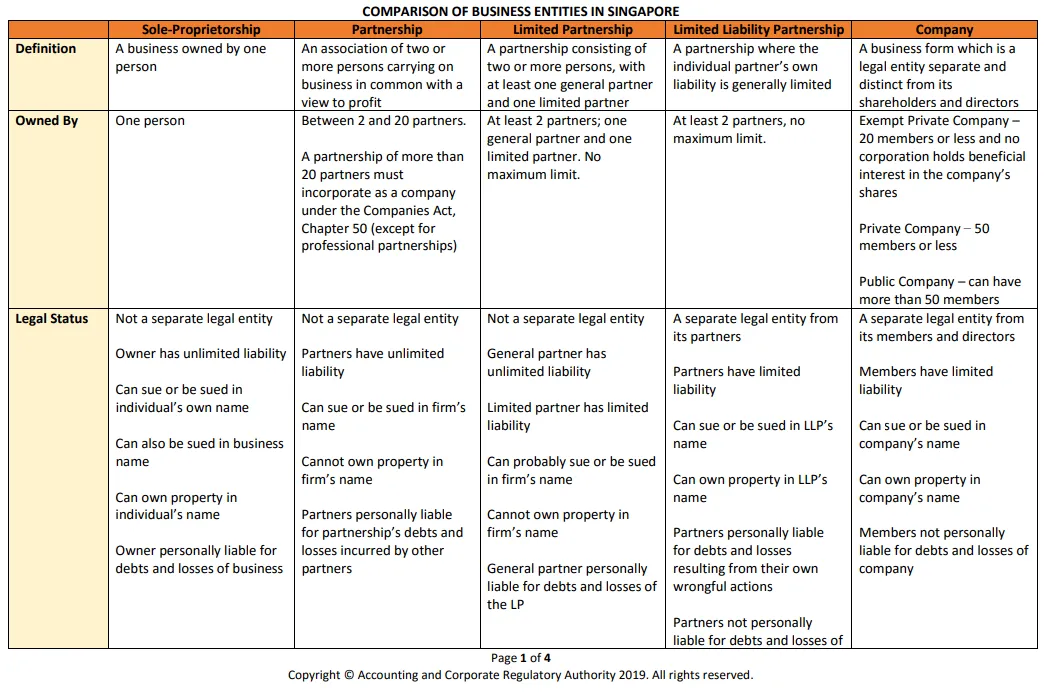
In Singapore, different types of business organizations can be categorized into five main types, including:
1)Sole-Proprietorship
A sole proprietorship means that the owner is personally liable for all debts and obligations incurred in the name of the business.
2)Partnership
In a partnership, each partner is jointly liable for all debts and obligations incurred by the partnership during its operation.
3)Limited Partnership
A limited partnership consists of at least one general partner and one limited partner.
4)Limited Liability Partnership
A limited liability partnership allows owners to operate flexibly as a partnership while having an independent legal identity similar to that of a private limited company.
5)Company
A company is a legal entity distinct from its members. In Singapore, a company must have at least one director who is a resident of Singapore and at least one secretary whose primary residence is in Singapore.
1 Company
A company has an independent legal status, distinct from its directors or shareholders. It can independently hold assets, and shareholders are not personally liable for the company’s debts or losses.
1)Exempt Private Company
2)Private Company Limited by Shares
3)Public Company Limited by Shares
4)Public Company Limited by Guarantee
5)Unlimited Private Company
6)Unlimited Exempt Private Company
7)Unlimited Public Company
2 Sole Proprietorship
A sole proprietorship is a business owned by a single individual or company, without any partners, giving the sole proprietor complete authority over the business operations.
1)A sole proprietorship is not an independent legal entity.
2)The owner has unlimited liability.
3)The owner can sue or be sued in their personal capacity.
4)If the individual has legal capacity, they can own business assets.
5)The owner is personally responsible for the business’s debts and losses.
3 Partnership
A partnership is a business entity formed by 2 to 20 partners. If the number of partners exceeds 20, the partnership must be registered as a company under Section 50 of the Companies Act.
1)A partnership is not an independent legal entity.
2)Partners have unlimited liability.
3)The partnership can sue or be sued in the name of the business.
4)The partnership cannot own property in the name of the business.
5)Partners are fully liable for the debts of the partnership and any losses incurred by other partners.
4 Limited Partnership
A limited partnership consists of two or more individuals, with at least one general partner and one limited partner.
1)It is not an independent legal entity.
2)General partners have unlimited liability, while limited partners have limited liability.
3)The partnership cannot own property in the name of the limited partnership.
4)General partners are personally liable for the debts and losses of the limited partnership.
5)Limited partners are not personally liable for debts or obligations beyond their agreed-upon contribution.
5 Limited Liability Partnership
A limited liability partnership consists of two or more individuals, with at least one general partner and one limited partner.
1)It is not an independent legal entity.
2)General partners have unlimited liability, while limited partners have limited liability.
3)The partnership cannot own property in the name of the limited partnership.
4)General partners are personally liable for the debts and losses of the limited partnership.
5)Limited partners are not personally liable for debts or obligations beyond their agreed-upon contribution.
II Company Registration Process in Singapore
The process of registering and incorporating a company in Singapore is very convenient and can be completed online, typically taking just 1-2 days. Applicants (directors residing in Singapore can use SingPass or CorpPass) or agents (such as law firms, accounting firms, or corporate secretarial firms) should prepare the necessary documentation and licenses and submit an online application through the Accounting and Corporate Regulatory Authority (ACRA) BizFile website.
1) Name
Check the availability of the chosen company name through the ACRA. If a name change is required after registration, a special general meeting must be convened, and approval from ACRA is needed.
2) Document Preparation and Submission
Prepare the company registration documents based on the approved company name and industry classification. This includes the company constitution, director's consent to act, shareholder information and share subscription details, disclosure of directors' interests, and directors' declarations. These documents must be signed by the company's directors and shareholders. Once ready, submit all registration documents and the company constitution to ACRA.
3) Shareholders, Directors, and Secretary
To change shareholders, it must be completed through a share transfer certificate and reported to ACRA. The position of company secretary must not remain vacant for more than 6 months under any circumstances.
4) Business Activities
A company is permitted to engage in all lawful business activities. During the registration process, it must select one to two primary business activities, and the Singapore Standard Industrial Classification (SSIC) codes can be verified on the ACRA website. Certain industries may necessitate the application for special licenses or permits from relevant authorities, which can take between 14 to 60 days to process.
5) Paid-up Capital
The minimum paid-up capital requirement is S$1. Following the registration and establishment of a bank account, the paid-up capital may be increased through the issuance of additional shares. Singaporean companies do not utilize authorized capital; rather, they issue ordinary shares, preference shares, or other forms of equity instruments.
6) Registered Address
A company must register a physical office address (which can be a residential or commercial property but cannot be a P.O. Box address). This address may differ from the actual operating or contact address. It will be used as the mailing address for government correspondence and for company registration and record-keeping purposes.
7) Employee Management
In accordance with legal regulations, apply for work visas for foreign employees and establish a Central Provident Fund (CPF) account for local employees (Singapore citizens and permanent residents).
