


Singapore, an international "Garden City," attracts a large number of foreigners to work, live, and do business. But did you know? To maintain harmonious development here, the Singapore government has a little secret—the quota policy! Simply put, it's a method of finely controlling the number of foreign talents to balance economic and social needs. Let's explore the secrets of Singapore's quota policy together!
I Analysis of Singapore's Quota Policy
As a country with limited geographical area and tight population resources, Singapore needs to finely manage the introduction of foreign talents to avoid putting too much pressure on the local job market. Additionally, the government also monitors the distribution of foreign talents across various industries and professions in real-time to ensure that it can meet the needs of national development and various industries while promoting the country's economic growth.
Hence, the specific numbers in Singapore's "quota policy" are determined based on the needs of each industry and the developmental needs of the nation and are also influenced by international situations and economic environments.
Moreover, the quota primarily applies to foreign employees holding Work Permits (WP) and S Passes (SP), aimed at encouraging employers to prioritize hiring local labor. Holders of Employment Passes (EP) are not affected by this quota.
II Quota Allocations by Industry
When we access the official website of the Ministry of Manpower (MOM) of Singapore, we can find a quota calculation page for different industries and years:
href=http://www.mom.gov.sg/passes-and-permits/work-permit-for-foreign-worker/foreign-worker-levy/calculate-foreign-worker-quota
On this page, we will see some proprietary terms. For easier understanding, let's first explain these terms:
Local Employees: Refers to full-time Singapore citizens or permanent residents
S Pass Holders: Refers to the number of employees an employer can hire on an SP
PRC Work Permit Holders: Refers to the number of employees from the People's Republic of China an employer can hire on a WP
NTS OL Work Permit Holders: Refers to the number of employees an employer can hire on an NTL OL WP (where NTS OL refers to India, Sri Lanka, Thailand, Bangladesh, Myanmar, Philippines)
Malaysian/NAS Work Permit Holders: Refers to the number of employees an employer can hire on a WP from Malaysia or NAS (where NAS refers to Taiwan, Macau, Hong Kong, and South Korea)
Next, let's select different industries on the official website and explain them in detail through screenshots!
1 Construction Industry
Taking the construction industry as an example, assuming a construction company employs 6 local employees, entering the corresponding data will automatically generate the number of SP and WP holders the company can hire, as shown in the figure below: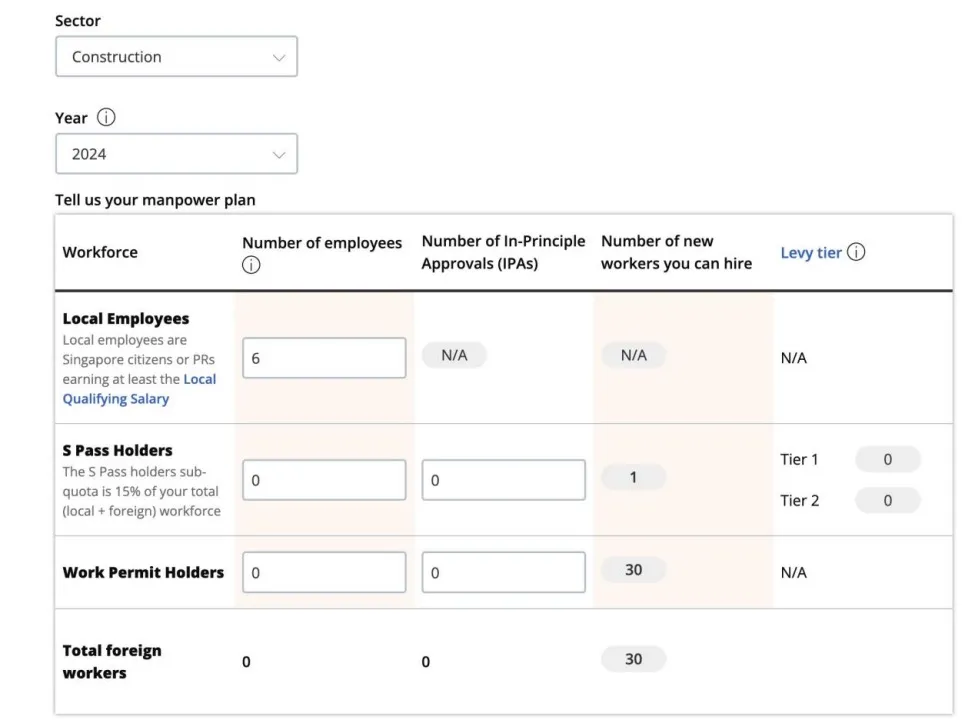
2 Manufacturing Industry
Taking the manufacturing industry as an example, assuming a manufacturing company employs 3 local employees, entering the corresponding data will automatically generate the number of SP holders, PRC WP holders, Malaysian or NAS WP holders the company can hire, as shown in the figure below: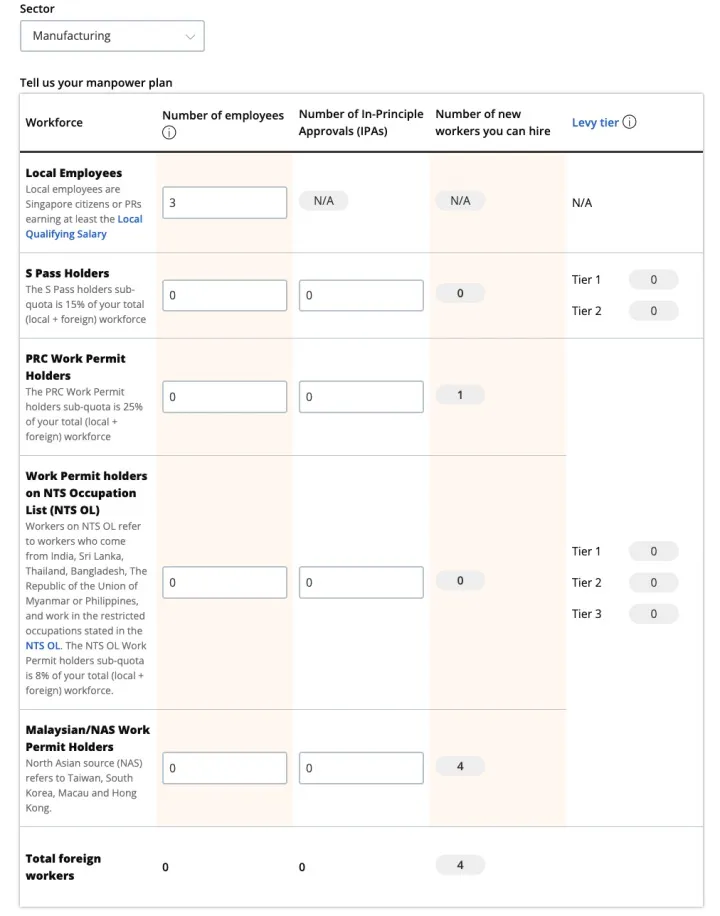
3 Services Industry
Taking the services industry as an example, assuming a service company employs 12 local employees, entering the corresponding data will automatically generate the number of SP holders, PRC WP holders, NTL OL WP holders, Malaysian or NAS WP holders the company can hire, as shown in the figure below: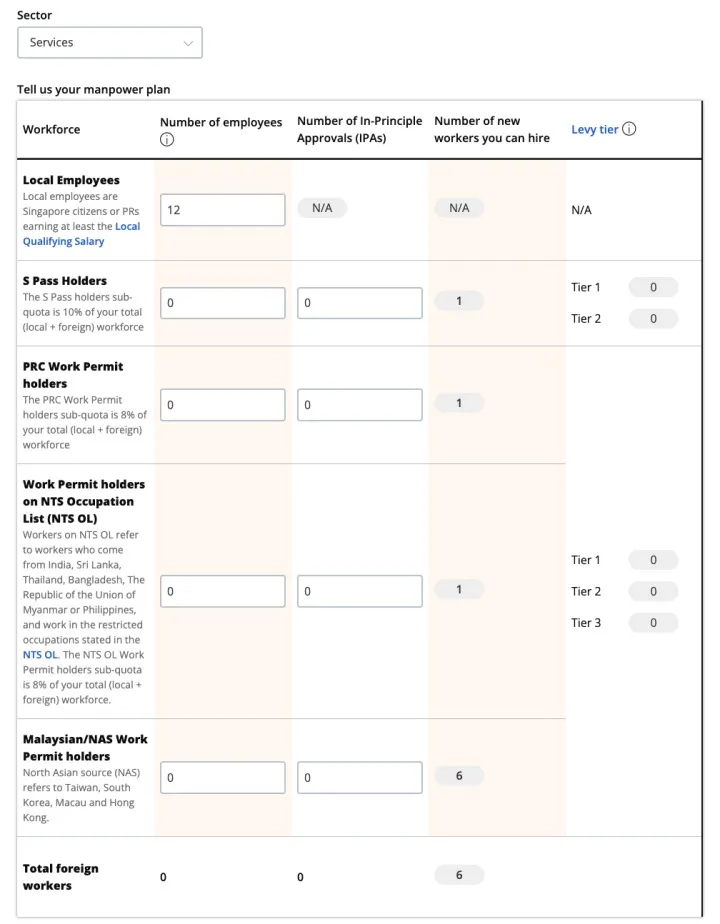
4 Marine Shipyard Industry
Taking the marine shipyard industry as an example, assuming a marine shipyard company employs 1 local employee, entering the corresponding data will automatically generate the number of SP holders, WP holders the company can hire, as shown in the figure below: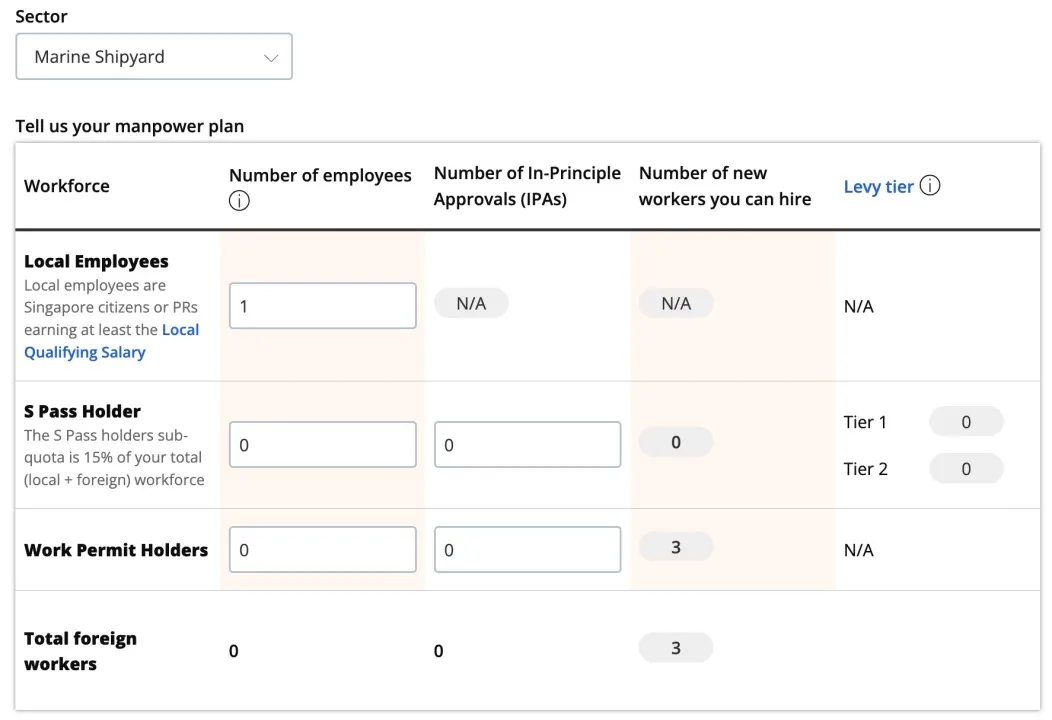
5 Process Industry
Taking the process industry as an example, assuming a process industry company employs 6 local employees, entering the corresponding data will automatically generate the number of SP holders, WP holders the company can hire, as shown in the figure below: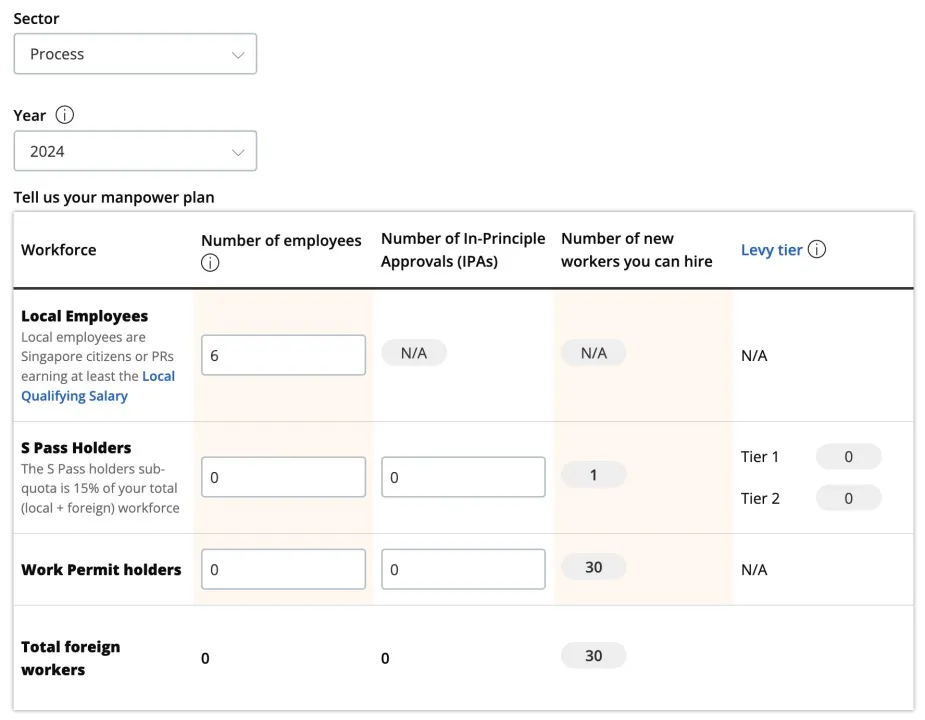
III Quota and Foreign Worker Levy
In Singapore, the number of foreign workers employed by a company is not only subject to quota restrictions but also to the Foreign Worker Levy. The Foreign Worker Levy, abbreviated as Levy, refers to the tax that employers need to pay monthly for each foreign worker they employ, until the worker's permit is canceled or expires.
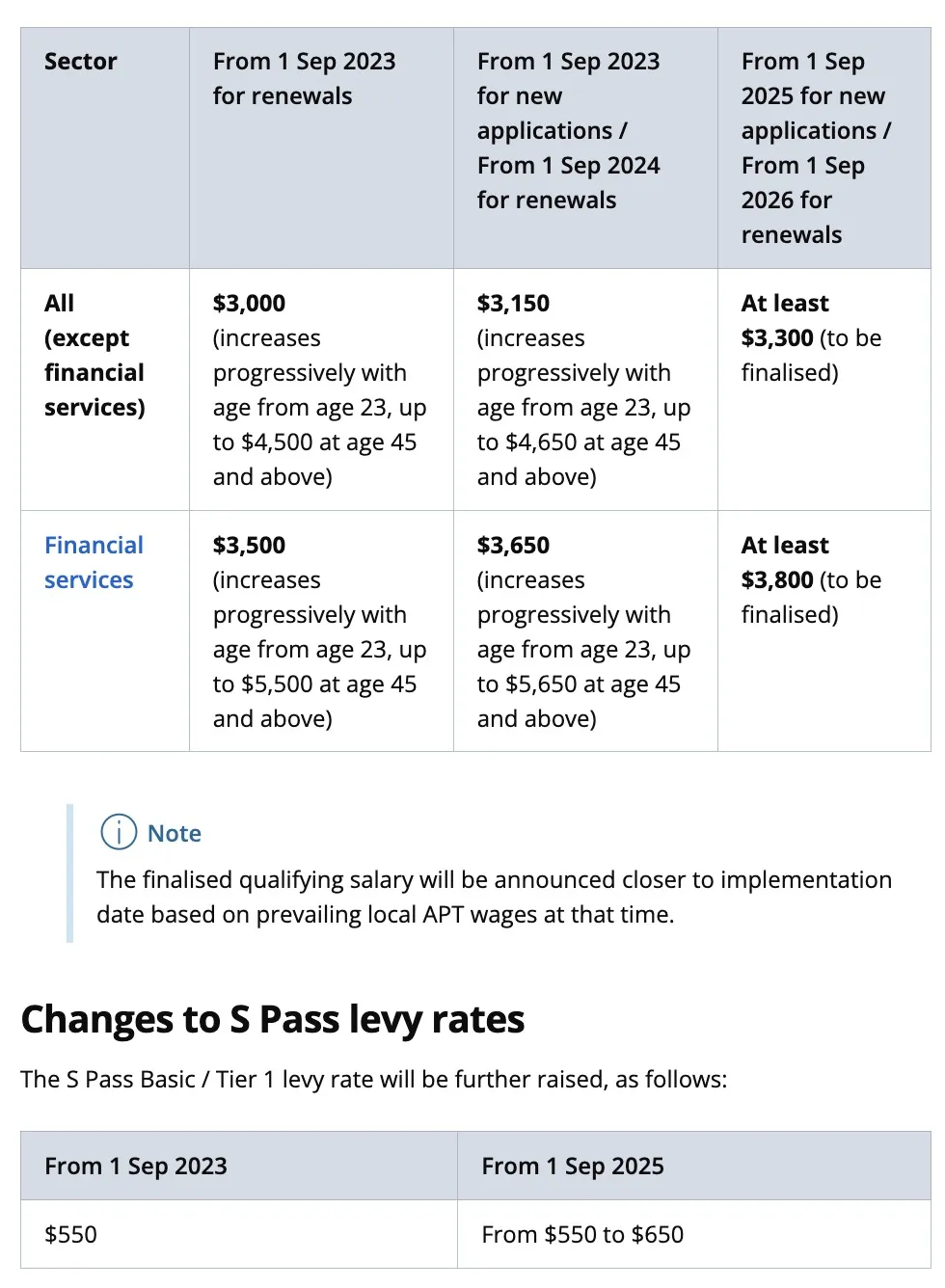
The levy rate is not fixed and is adjusted by MOM according to economic conditions. For instance, a recent adjustment implemented new regulations for S Pass holders starting in 2025 (as shown in the figure below):
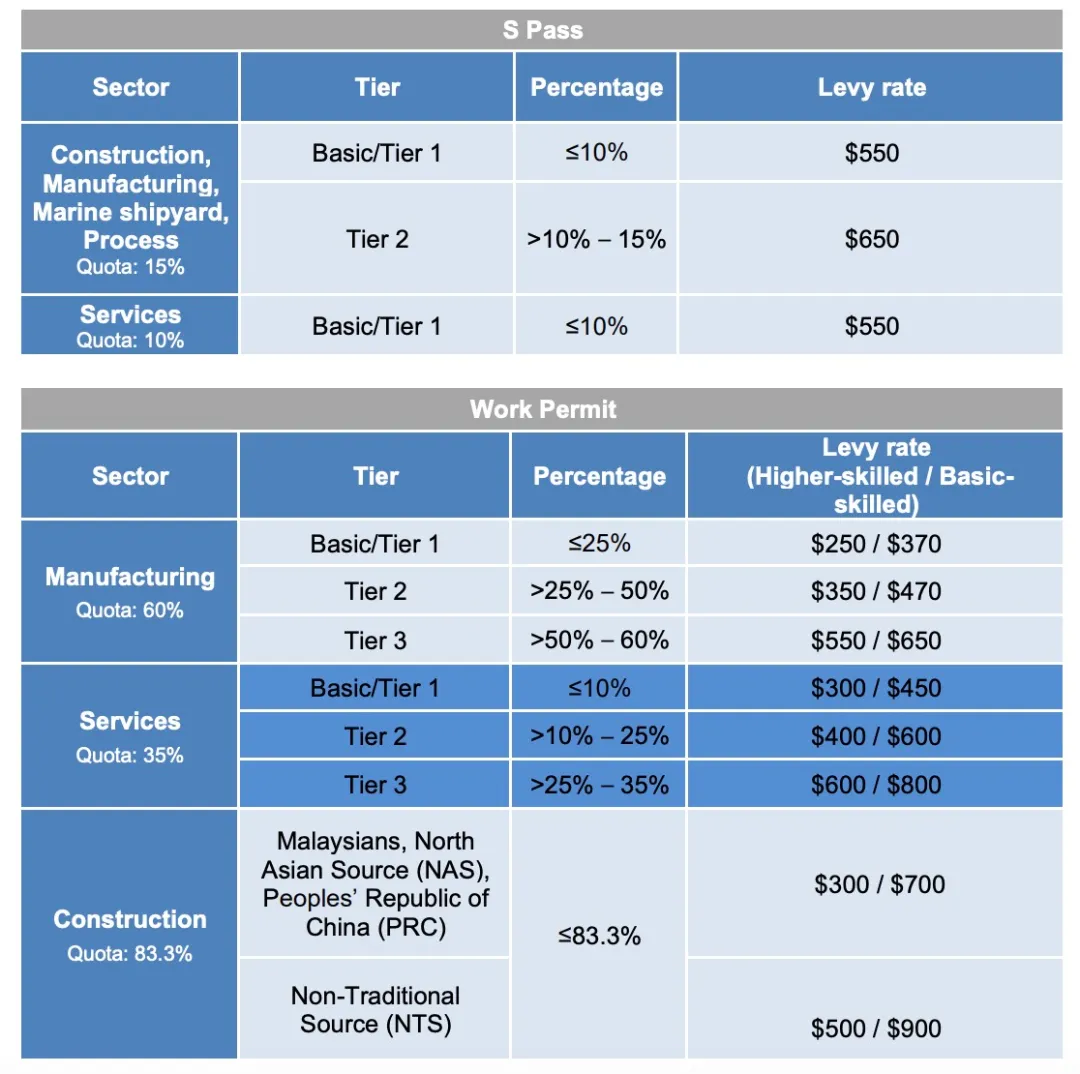
Additionally, the levy rate varies by industry and is distributed in a tiered manner. In simple terms, the more foreign employees a company hires, the higher the levy it needs to pay. The figure below, available on the MOM official website, shows the quota, levy, and levy rates for different industries (latest version as of January 2024):
IV Quota Calculation Method: Central Provident Fund (CPF)
The MOM verifies the number of local employees through the company's CPF (Central Provident Fund) account to determine the foreign labor quota.
Since the number of local employees may fluctuate, MOM uses the average CPF contributions over more than 3 months as the basis for calculation. The quota is usually updated twice a month, once at the beginning of the month and once in the middle of the month (around the 15th), based on the average CPF contributions over the past 3 months. If employers submit CPF contributions before the 15th of the month, the contributions will be included in the next month's quota calculation. For example, CPF contributions made before February 15th will be used for March's quota calculation. To ensure accurate quota calculation, some companies choose to prepay CPF contributions before the 15th, ensuring they receive new quota information at the beginning of March. Conversely, if CPF contributions are delayed, they will not be included in the foreign worker quota, even if late payments and fines are subsequently made.
If a company's employment exceeds the quota, new applications and renewals for WP and SP will be rejected. If a company continues to exceed the quota, previously approved permits may be at risk of cancellation. If one local employee's CPF comes from three or more employers, that employee will not be counted in the quota; however, if the employee has both full-time and part-time jobs, they will not be affected.
To facilitate understanding, let's take a Sichuan restaurant as an example. A Sichuan restaurant falls under the service industry and needs to recruit chefs and waiters. Due to the quota system, employers may prioritize hiring Malaysian or NAS employees to more easily obtain permits. Some employers may even opt to apply for the more challenging EP to avoid the burden of the foreign worker levy and CPF contributions.
This is the quota system in Singapore—it sounds a bit complicated, doesn't it? Don't worry, we can help you sort everything out!
Whether it's the details of the quota or the application for permits, if you want to know more or have any questions, please click on our contact information. Our professional team is always ready to assist you!
