


Singapore has always been a global leader, embracing openness and encouraging the influx of top talent and businesses. In the coming years, more and more new companies will be established in Singapore. So, how do you register a company and open a bank account in Singapore? What are the processes for company registration, bank account opening, EP and DP applications, as well as accounting, auditing, and tax filing? Let's explore these steps together today.
I. Company Registration
To register a company in Singapore, you need to prepare the following documents: identification documents, proof of address, and relevant registration documents.
1 Company Registration Requirements
(1)Provide a proposed company name in English.
(2)The minimum share capital is SGD 1, with no upper limit. You can also choose other currencies such as USD, RMB, etc.
(3)Provide a local Singapore address for the registered office, suitable for business use. P.O. Box addresses are not allowed.
(4)Specify 1-2 primary business activities.
(5)Directors must be at least 18 years old, with no maximum age limit. If there are multiple shareholders, the shareholding ratios must be confirmed. There must be at least one director; if there is only one director, they must be a Singapore citizen or permanent resident. If there are multiple directors, at least one must be a Singapore citizen or permanent resident.
(6)Appoint a company secretary who is a resident in Singapore or a Singapore-based company.
A Singapore resident refers to a Singapore citizen, Permanent Resident (PR), or EntrePass holder.
2 Company Registration Materials
(1)Passports and identification cards of the directors and individual shareholders who will serve on the Singapore company board.
(2)Proof of address for the directors and shareholders. Examples include a bank statement, utility bill, or phone bill issued within the last 3 months showing their name and address (if the address differs from the one on their ID).
(3)If a company is acting as a shareholder, provide copies of the company's business license and articles of association, proof of address, and a shareholding structure chart.
(4)Contact information for directors and shareholders, including phone numbers, email addresses, and mailing addresses.
3 Company Registration Process
(1)Check Availability of Company Name
Submit the proposed company name to the Accounting and Corporate Regulatory Authority (ACRA) to check for availability. Note that the company name must be in English, as Singapore does not currently support Chinese names. Typically, the company name ends with "PTE. LTD."
(2)Fill in Information and Provide Documentation
Complete the Singapore company registration application form and customer information survey form, including details such as: company name, registered address, primary business activities, share capital, directors, shareholders, and information on the beneficial owners. Provide identification and other relevant documents.
(3)Submit Documents
Submit the company registration application to ACRA.
(4)Registration Completion
Once the registration is complete, you will receive the full set of company documents.
II. Bank Account Opening
1 Choose the Bank for Account Opening
The major local banks in Singapore are DBS Bank (DBS), United Overseas Bank (UOB), and Oversea-Chinese Banking Corporation (OCBC).
Chinese banks include Bank of China, Industrial and Commercial Bank of China (ICBC), China Construction Bank (CCB), Agricultural Bank of China (ABC), Bank of Communications, and China Merchants Bank (CMB).
International foreign banks include Citibank, Standard Chartered Bank, HSBC, and BNP Paribas.
2 Singapore Company Documents
These include the Singapore company registration certificate, articles of association, company seal, and personal creditworthiness proof of the company directors and shareholders.
(1) Personal identification documents of directors and shareholders, such as identity cards, passports, and address proof issued within the last three months.
(2) Personal bank statements of directors and shareholders.
(3) Employment proof of directors and shareholders, including a complete labor contract and social security payment records.
(4) Two to three sets of complete business documents, including purchase contracts, sales contracts/commercial invoices, bills of lading, and corresponding bank transaction proofs for upstream and downstream transactions.
(5) KYC (Know Your Customer) form for account opening.
3 Provide Affiliated Company Documents
If the directors or shareholders own affiliated companies in other countries or regions, documents of the affiliated companies are also required.
4 Successful Account Opening and Normal Use
Once the account and internet banking are obtained and activated, business operations can commence normally.
5 Digital Banking
Due to the tightening policies of traditional bank account openings, especially for SMEs and startups, the Singapore government is actively developing digital financial services to maintain its world-leading business environment. The aim is to become a hub that combines both traditional and emerging digital financial centers. Digital banks offer more convenient, friendly, and cost-effective company accounts compared to traditional banks, providing significant benefits to SMEs and new enterprises in Singapore.
(1) What is a Digital Bank?
A digital bank in Singapore is licensed by the Monetary Authority of Singapore (MAS) to operate digital banking services through digital channels such as the internet and mobile applications. Digital banks have no physical branches; all operations are conducted online. They offer a range of digital financial services, including opening digital bank accounts, payments, loans, investments, and insurance. In recent years, Singapore's financial regulators have started authorizing the operation of digital banks, providing businesses and individuals with more convenient, efficient, and cost-effective financial services.
(2) What are the Advantages of Digital Bank Accounts Compared to Traditional Bank Accounts?
① Convenience: Digital bank accounts can be opened without the need to be physically present in Singapore. Accounts can be opened quickly by filling out information online and completing KYC certification.
② Lower Threshold: Digital bank accounts do not require large deposits. Many digital banks offer accounts with zero minimum deposits.
③ Faster Processing: Digital bank accounts can typically be opened within 2-8 weeks, meeting the business needs for timely transactions.
④ Simplified Process: The account opening process for digital banks is relatively straightforward. Generally, it involves filling out an online application form, providing basic materials and information about the company and directors, and activating the account upon approval.
⑤ 24/7 Service: Digital banks offer round-the-clock customer service, allowing users to access account information and conduct transactions at any time.
⑥ Payment Integration: Digital bank accounts can be linked with other digital payment platforms and applications, such as PayNow and GrabPay.
⑦ Innovative Services: Digital bank accounts utilize big data analysis to help customers better manage their funds, predict future expenditures, and provide personalized financial services.
III. Applying for an EP
After registering the company, set up Corppass, apply for a CPF account (1-2 business days), register with MOM, then apply for EPOL (2-3 business days), and after that, you can directly submit the EP application.
1 Documents Required for EP Application:
(1) Personal Documents
① Scanned copies of the applicant's passport and identity card
② Bachelor's degree or higher certificate + translation (if the degree certificate is not in English, it must be translated by a certified translator). English version of the degree certificate issued by the credential evaluation agency.
(For Chinese degrees, provide the English translation certified by https://www.cdgdc.edu.cn/)
③ Personal resume, job description, and employment contract
④ Other possible supplementary documents
(2) Company Documents
① It is recommended that the company's registered capital be at least SGD 200,000 and fully paid up.
② Job posting for at least 28 days, including interview arrangements and data statistics
③ Possible required documents: business contracts, invoices, and bank statements
④ Possible required documents: lease contract for office space for more than 6 months (can be a shared desk lease contract or an office lease contract)
⑤ Possible required documents: CPF contribution records if local employees are hired
⑥ Possible required documents: a list of the company's top 3 clients
⑦ Other supplementary documents that may be required by the Ministry of Manpower
(3) Office Address Leasing for a Workstation
SGD 700/month + GST. For the EP application, a lease contract of at least 6 months is required. The cost is SGD 700 * 6 + GST = SGD 4,200 (excluding tax), or you can rent an entire office.
2 Estimated Application Time
Once all the documents are prepared, it takes approximately 2 months from the submission date to get the results. The approval depends on the comprehensive assessment by the Ministry of Manpower based on the company and individual's circumstances.
IV. DP Application
Dependant's Pass (DP)
Eligible dependents include legally married spouses and unmarried children under 21, including legally adopted children.
1 Dependant's Pass (DP)
(1) Legally married spouse
(2) Unmarried children under 21 years old, including legally adopted children
2 Application Requirements
(1) The applicant must hold an Employment Pass or S Pass
(2) The applicant must earn a minimum fixed monthly salary of SGD 6,000. This is based on the applicant's salary, not the total household income
(3) The application must be sponsored by a well-established company registered in Singapore (usually the applicant’s employer)
3 Documents Required for Application
Copy of the personal particulars page of the passport
For children sharing a passport with their parents, the personal particulars page of the parents must also be submitted
You may need to submit additional documents depending on the family member being applied for:
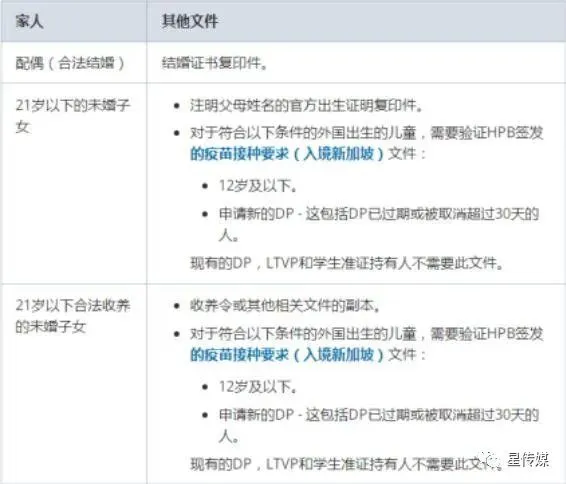
V. Schedule for Accounting, Auditing, and Tax Filing
1 Financial Year and Tax Filing Timeline for Singapore Companies
(1) Financial Year
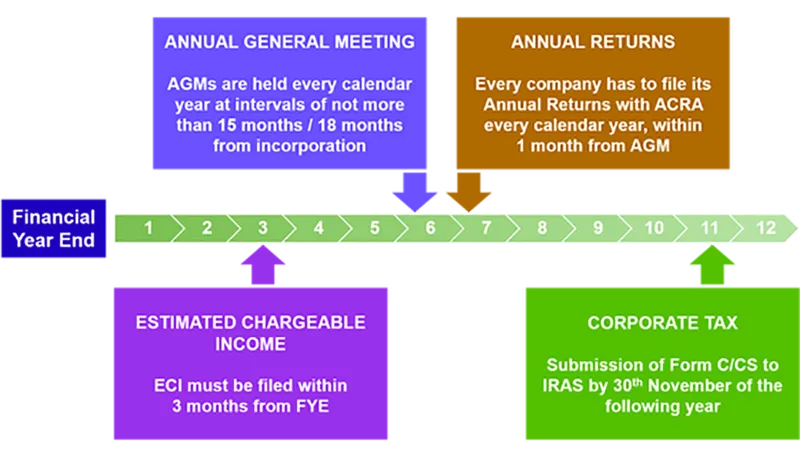
The financial year for tax filing for Singapore companies is generally 12 months. The first year can be extended to 18 months. Due to the tax relief for newly established companies for the first three years, it is recommended to keep the financial year at 12 months and handle it together with the annual review. The company’s tax filing deadline is November 30th each year.
(2) Estimated Chargeable Income (ECI)
The ECI must be filed within three months after the end of the financial year. After filing, the Inland Revenue Authority of Singapore (IRAS) will issue a tax notice based on the ECI form. Typically, the tax notice will be received 1-2 months after the ECI submission deadline. The relevant tax must be paid within one month of receiving the notice.
(3) Form C Tax Return
With a deadline of December 31st each year, for companies with a financial year ending on or before December 31st of the same year, the Year of Assessment (YA) is the following year. For example, for the accounting period from April 1, 2010, to March 31, 2011, the YA is 2012. The Form C for YA 2012 will be issued around April each year, reporting the previous year's taxes. If there are discrepancies with the ECI filing, adjustments can be made. The submission deadline is November 30, 2012. IRAS will issue a tax notice upon receiving Form C, and the tax must be paid within one month.
2 Singapore Company Tax Filing Process
The entire process involves three stages: Estimated Filing, Annual Filing, and Tax Calculation and Payment.
(1) Estimated Tax Filing
Within one month after the first Annual General Meeting (AGM), the Singapore company must complete its annual review with the Accounting and Corporate Regulatory Authority (ACRA). Within three months thereafter, the Inland Revenue Authority of Singapore (IRAS) will issue an Estimated Chargeable Income (ECI) form to the company. The company needs to estimate the revenue for the next year and submit this information in the ECI form to IRAS.
(2) Issuance of Tax Form
In March of the following year, IRAS will send a Form C tax return to the company, requesting the company to report the tax information for the previous financial year.
(3) Organize Financial Information and Fill Out the Tax Form
The company needs to fill out the Form C, attach supporting documents (such as financial statements, audit reports, etc.), and submit them to IRAS for tax assessment.
(4) Tax Calculation and Payment by IRAS
Once IRAS completes the tax calculation, they will issue a Notice of Assessment. The company must pay the tax amount specified in the notice, thus completing the tax filing process.
VI. ACRA Annual Filing Process
According to the Accounting and Corporate Regulatory Authority (ACRA) in Singapore, all registered companies (except those exempted) must submit their financial statements (FS) in XBRL format.
1 Submission to the Accounting and Corporate Regulatory Authority (ACRA)
ACRA is the national regulator of business entities and public accountants in Singapore, and all new business registrations must go through ACRA. The annual filing with ACRA is a mandatory task for all registered companies in Singapore. It verifies that the company is still operational and updates its information in the records of the corporate registry. Failure to submit or late submission of the annual return can result in fines, and the company could be struck off. The steps for ACRA annual filing include verifying company details, preparing and submitting the form and necessary documents, and paying the required fees. In Singapore, private companies must file their annual return within 7 months after the end of their financial year.
Since 2014, the Singapore government has required companies to submit financial statements in the eXtensible Business Reporting Language (XBRL). XBRL is a computer-based language for presenting financial statements and is used for electronic communication of business and financial data worldwide. The format is open-source and freely available.
ACRA has revised the filing requirements and data elements for companies' XBRL submissions. This is part of the effort to simplify the filing of financial statements (FS).
2 XBRL Templates
Companies can use four templates to meet the revised filing requirements and data elements:
(1) Full XBRL Template
This template reduces the number of data elements by 50%, to approximately 210 data elements. It captures information from primary statements and selected notes to the financial statements (FS).
(2) Simplified XBRL Template
This template replaces the XBRL FSH (General) and contains approximately 120 data elements. It captures comprehensive information in the statement of financial performance and position.
(3) XBRL FSH (Banking) Template
This template has minor changes and includes approximately 80 data elements.
(4) XBRL FSH (Insurance) Template
This template also has minor changes and includes approximately 80 data elements.
Most companies must submit their reports using the full XBRL template. Smaller non-publicly accountable companies are eligible to use the simplified version of the XBRL template, which requires far fewer elements compared to the full template.
A company is considered a "smaller company" if it meets the criteria of having both annual revenue and total assets not exceeding SGD 500,000 each for the financial year. The assessment of revenue and total assets should be based on the financial statements prepared in accordance with the Companies Act. When a company has control, joint control, or significant influence over another entity, its revenue and total assets should be assessed on a consolidated basis, unless exempted from preparing consolidated financial statements by accounting standards or ACRA.
The SGD 500,000 thresholds are determined based on the financial statements, regardless of the number of months covered in the financial year. For financial statements presented in foreign currency, revenue should be converted using the average exchange rate for the financial year, and total assets should be converted using the closing exchange rate at the end of the financial year.
